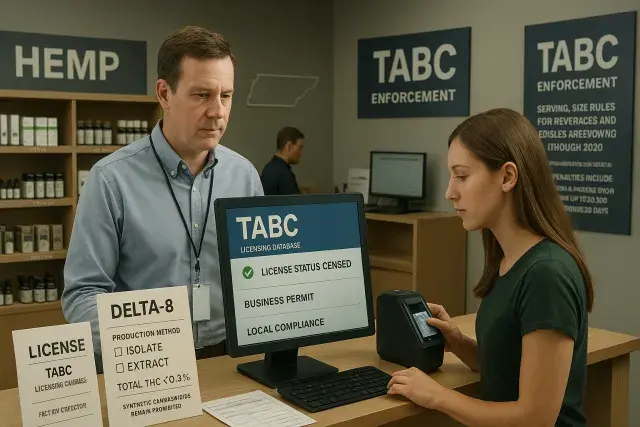
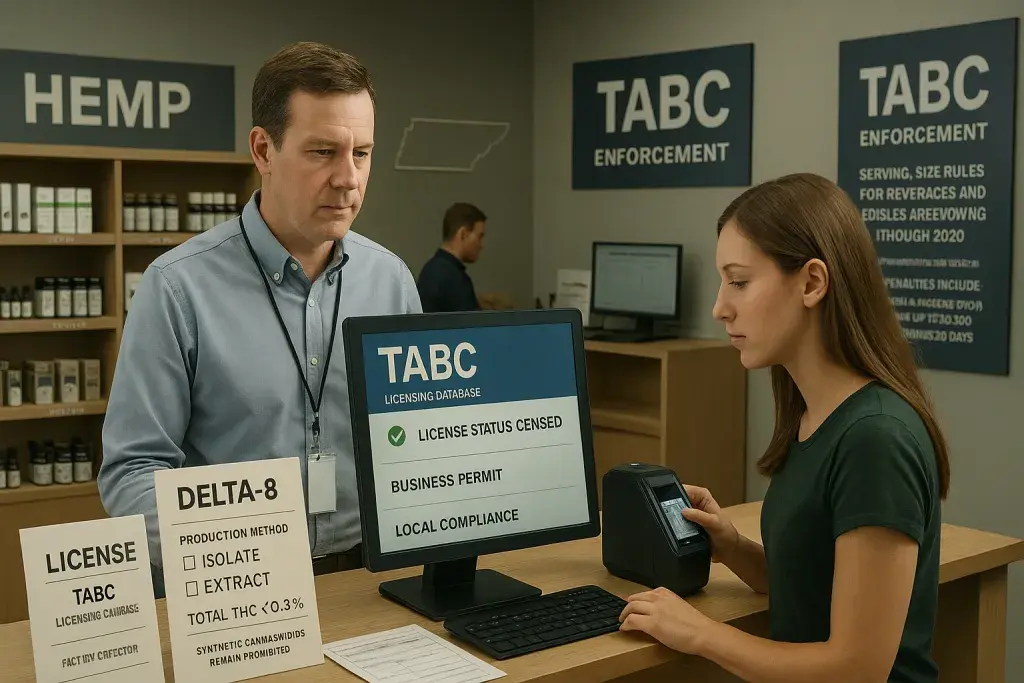
Tennessee's hemp market changed structurally this year, not cosmetically. Public Chapter 526 moved regulatory authority over hemp-derived cannabinoid products from the Department of Agriculture to the Tennessee Alcoholic Beverage Commission, a shift that puts hemp retail under an agency built around licensing, enforcement, and age-gated sales rather than crop oversight. For operators, that distinction is not academic. It changes what "compliant" actually means at the point of sale.
Retailers now need an applicable TABC license to sell hemp-derived cannabinoid products legally, and a local business license or general retail permit does not substitute for that authorization. This matters for store owners building out compliance workflows, because verification now has to happen at two levels: confirming the product's certificate of analysis and confirming the seller's standing with the state. Operators managing multiple SKUs across tinctures, vapes, and edibles are increasingly leaning on integrated back-office systems, and many are already running licensing documentation, batch tracking, and age verification through an all-in-one dispensary platform rather than juggling separate spreadsheets and paper files. That kind of consolidation is becoming less of a convenience and more of a defensive necessity as enforcement infrastructure catches up to the statute. all-in-one dispensary platform
The Delta-8 Problem Retailers Can't Test Their Way Around
Here's the catch that trips up a lot of otherwise careful compliance programs: a certificate of analysis showing total THC under 0.3% does not, by itself, establish that a Delta-8 or Delta-10 product is lawful in Tennessee. State rules also prohibit synthetic cannabinoids, and most commercial Delta-8 and Delta-10 on shelves nationally is produced through chemical conversion of CBD isolate, not extracted directly from the plant in meaningful quantities. That production method, not the THC percentage on the lab report, is what determines legality under current Tennessee rules.
For wholesalers and brands selling into Tennessee, this means manufacturing disclosure needs to travel with the product, not just potency data. A COA that satisfies a distributor in a less restrictive state may be functionally incomplete for a Tennessee retailer's compliance file. Buyers building wholesale menus should be asking suppliers direct questions about synthesis pathways before those products ever reach a shelf.
Where the Real Penalty Exposure Sits
Tennessee has no medical cannabis dispensary system and no adult-use pathway. Marijuana possession above the hemp threshold remains a Class A misdemeanor in most cases, carrying up to 11 months and 29 days and fines up to $2,500 - figures frequently understated in consumer-facing guides that mistake statutory minimum fines for maximums. Felony exposure comes from manufacture, distribution, or possession with intent, not from a simple count of prior possession convictions.
For retailers, the compliance stakes are different but no less serious. Selling non-compliant product, whether through mislabeled THCA flower exceeding the 0.3% total THC calculation or unverified Delta-8, exposes a business to licensing risk under an agency with far more enforcement muscle than the previous framework offered.
Operational Takeaways for Retailers and Suppliers
- Confirm TABC license status directly through the state database rather than relying on displayed certificates or general business permits
- Require documentation of production method, not just THC percentage, from Delta-8 and Delta-10 suppliers
- Maintain age verification at 21 and older for all hemp-derived cannabinoid products, including topicals and transdermal formats
- Treat THCA flower as a compliance liability unless batch-tested under the state's total THC formula
- Expect serving-size and packaging rules for edibles and beverages to keep evolving through the 2026 transition period
None of this makes Tennessee's hemp market unworkable, but it does make it less forgiving for operators still running on last year's assumptions. The state effectively imported an alcohol-style regulatory posture into a product category that many retailers had been treating as lightly regulated. That gap between old habits and new oversight is where the compliance risk actually lives.