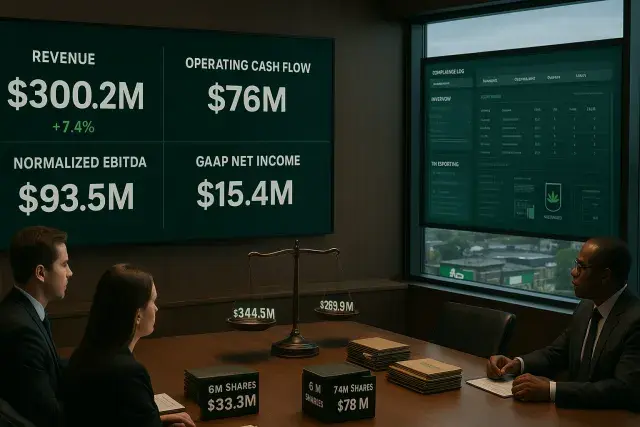
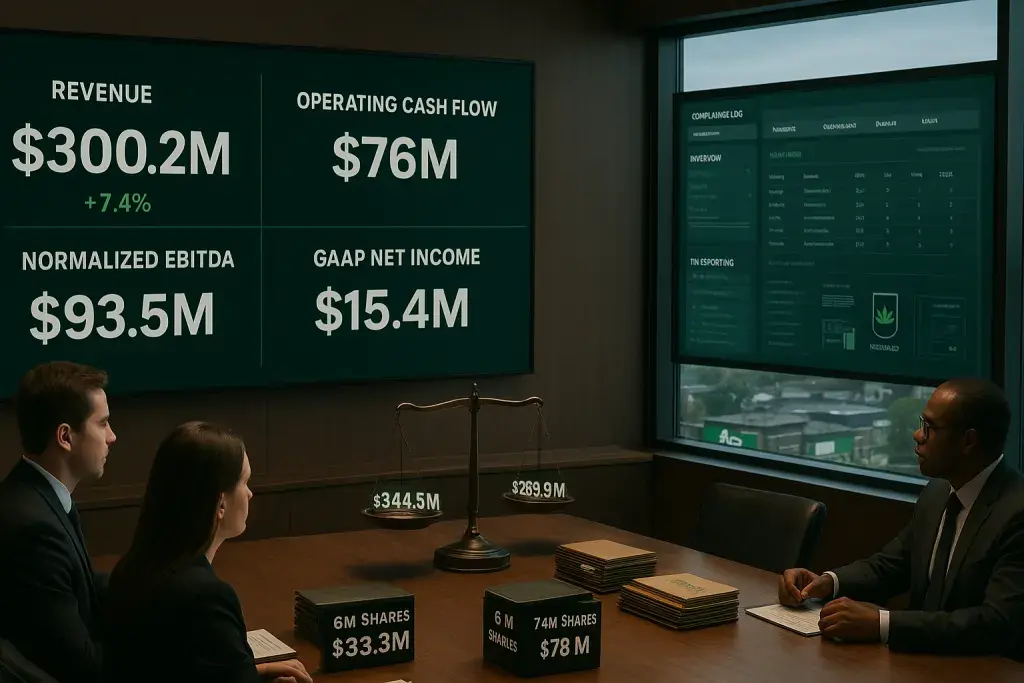
Green Thumb Industries (OTC: GTBIF) closed the first quarter with a financial profile that most multi-state operators can only describe in a pitch deck, not a filing. Revenue rose 7.4% year over year to $300.2 million, but the more telling numbers sit below the top line: $76 million in operating cash flow, $93.5 million in normalized EBITDA, and GAAP net income of $15.4 million. That combination - growth paired with actual profitability - remains rare enough in this sector that it deserves scrutiny rather than applause alone.
The industry's last five years offer a blunt lesson in why cash generation matters more than revenue headlines. Operators leaned on debt, repeated equity raises, and aggressive store expansion to chase market share, only to find themselves squeezed by Section 280E tax burdens and thin wholesale margins once the capital markets tightened. Green Thumb largely sidestepped that trap by keeping its balance sheet conservative and its expansion selective. Underpinning that discipline is also an operational backbone that many operators underestimate: accurate seed-to-sale cannabis software tracking that keeps compliance logs, inventory shrinkage, and tax reporting tight enough to avoid the costly reconciliation problems that have tripped up less organized chains. seed-to-sale cannabis software
What stands out operationally is the balance sheet itself. Green Thumb ended the quarter with roughly $344.5 million in cash and equivalents against $289.9 million in total debt - a ratio that would be unremarkable in most retail sectors but is genuinely uncommon in cannabis. Rather than issuing new shares to fund growth, a move that dilutes existing holders and has burned plenty of cannabis investors before, management repurchased about 6 million shares for $33.3 million during the quarter and another 7.4 million shares afterward, pushing 2025 buybacks toward $78 million. That's a company signaling confidence with its own capital, not someone else's.
Why Store-Level Discipline Still Matters
Green Thumb now runs more than 110 Rise dispensaries nationally, spanning both medical and adult-use markets. The company has continued to add locations in places like Minnesota and Texas, but the pattern is incremental rather than aggressive. In practice, that means fewer half-built retrofits, fewer POS terminal rollouts done in a rush, and less exposure to markets where license caps or social equity licensing delays can strand capital for years. Operators watching this closely should note that store growth without matching compliance infrastructure - proper lab testing protocols, compliant packaging, reliable COA documentation - tends to be where budgets quietly bleed out.
The Limits of Even a Well-Run Operator
None of this makes Green Thumb immune to the pressures facing the broader industry. Federal legalization remains unresolved, 280E still erodes net margins in ways ordinary retailers never face, and pricing pressure in mature adult-use states continues to compress wholesale menus. Smaller, higher-risk operators may still offer sharper upside if federal reform moves faster than expected. But for dispensary operators, suppliers, and investors evaluating who actually survives a prolonged period of regulatory limbo, Green Thumb's approach - profitability under today's rules, not tomorrow's promises - offers a useful operating model, even if it isn't the flashiest one on the board.