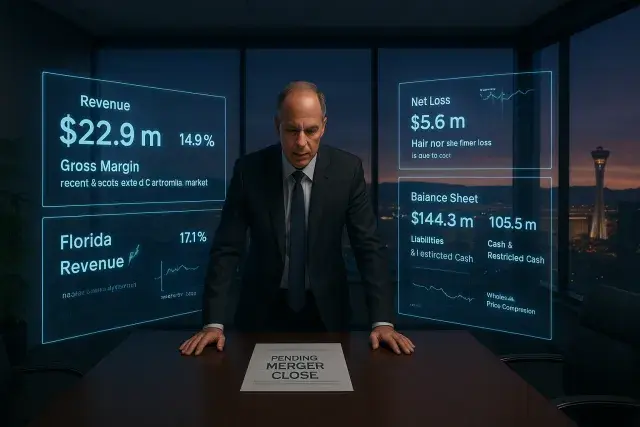
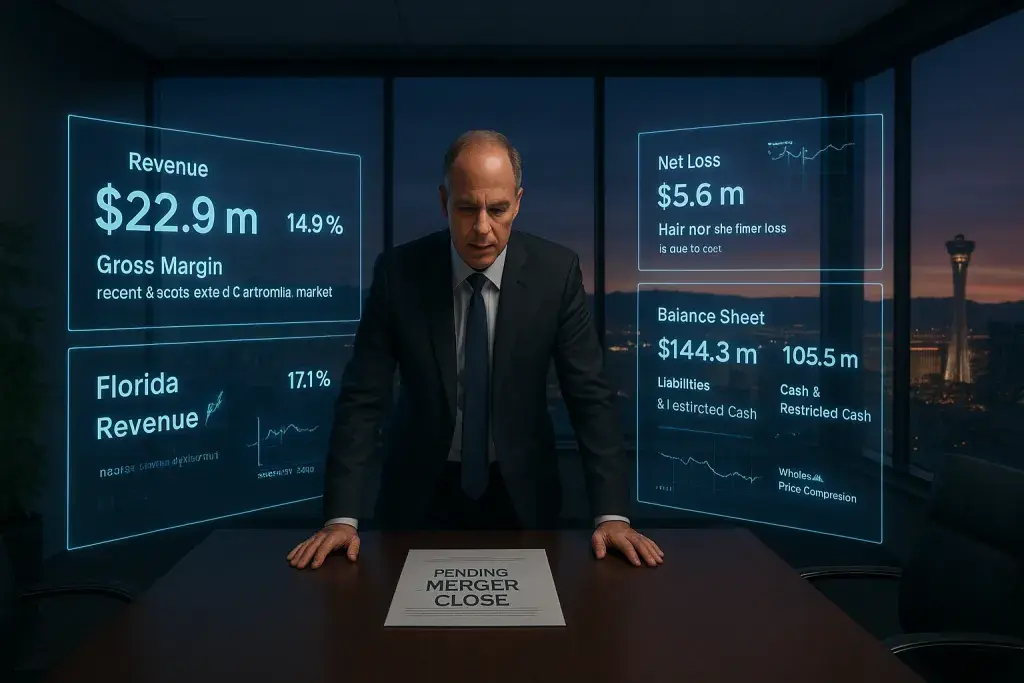
Planet 13 Holdings reported second-quarter 2026 revenue of $22.9 million, down 14.9% from a year earlier, but gross margin climbed to 53.9% as the multi-state operator worked through a California exit and a round of company-wide cost cuts. The Las Vegas-based company posted a net loss of $5.6 million, roughly half of last year's $13.3 million loss, and narrowed its Adjusted EBITDA loss to $0.5 million from $2.4 million. The quarter arrives as Planet 13 moves toward closing its previously announced merger with Vireo Growth Inc., a deal that reshapes how investors should read these numbers.
Smaller Top Line, Cleaner Operations
Here's the catch with a top-line decline that actually reads as good news: Planet 13's revenue drop was largely a function of choices, not just market pressure. Exiting California retail and wholesale removed a segment that had been dragging on margin, and management paired that exit with procurement and cost initiatives that pushed gross margin up more than ten points year over year. Strip out a one-time $1.0 million reduction in the Florida distillate inventory reserve, and adjusted gross margin still lands at 49.5%, a meaningful improvement for an operator that has spent recent quarters fighting price compression in Nevada and Florida. Total expenses fell 17.7% to $15.2 million, evidence that the cost discipline extended beyond gross margin into overhead.
Florida is the notable bright spot. Revenue there grew 17.1% sequentially, a signal that Planet 13's push to stabilize that market - including a May OMMU approval for a BHO extraction facility and a planned Sarasota store announced in July - is translating into actual sales momentum rather than just square footage. For a state with a competitive medical market and its own testing and packaging requirements under OMMU oversight, sequential growth of that size is not a small thing operationally; it means fewer stockouts, tighter SKU management, and less excess distillate sitting in inventory drawing down reserves.
Balance Sheet Still Under Pressure
Total assets slipped to $144.3 million from $152.3 million at year-end 2025, while total liabilities rose to $105.5 million from $101.2 million. Cash and restricted cash ticked up slightly to $16.5 million. That combination - shrinking assets, growing liabilities, modest cash - is the balance-sheet picture of a company managing through consolidation rather than expansion, which tracks with a multi-state operator that has spent the past year trimming footprint in one state while trying to hold share in others under continued wholesale price compression.
Section 280E remains the backdrop for every one of these figures, even when the release doesn't say so directly. Federal tax code still disallows standard business deductions for plant-touching cannabis companies, which means net income and Adjusted EBITDA carry more weight than they would for an unregulated retailer of the same size. Investors and operators watching this report should keep that structural tax burden in mind when comparing Planet 13's margins to any non-cannabis retail peer.
The Merger Changes What This Report Means
Planet 13 skipped its usual earnings call this quarter, citing the pending merger with Vireo Growth. That's a practical signal, not just a scheduling note. Co-CEO Bob Groesbeck framed the deal as a bet on scale - more purchasing power, broader distribution, a balance sheet built to absorb continued price compression across state markets. In practice, though, that framing also tells shareholders how to read this quarter's results: less as a standalone performance snapshot and more as a final data point before the combined entity's structure takes over as the relevant story.
For operators and suppliers watching from outside, the arrangement is a reminder of where the multi-state cannabis sector is heading. Single-state price compression, driven by expanding license counts and oversupply in markets like Nevada, is pushing even established vertically-integrated brands toward consolidation rather than organic growth. Wholesale partners, landlords, and payment providers tied to Planet 13's footprint in Nevada, Illinois, and Florida will want clarity on how store operations, POS systems, and compliance logs transition once the merger closes, since integration of seed-to-sale tracking and vendor relationships tends to be where these deals get complicated in practice.