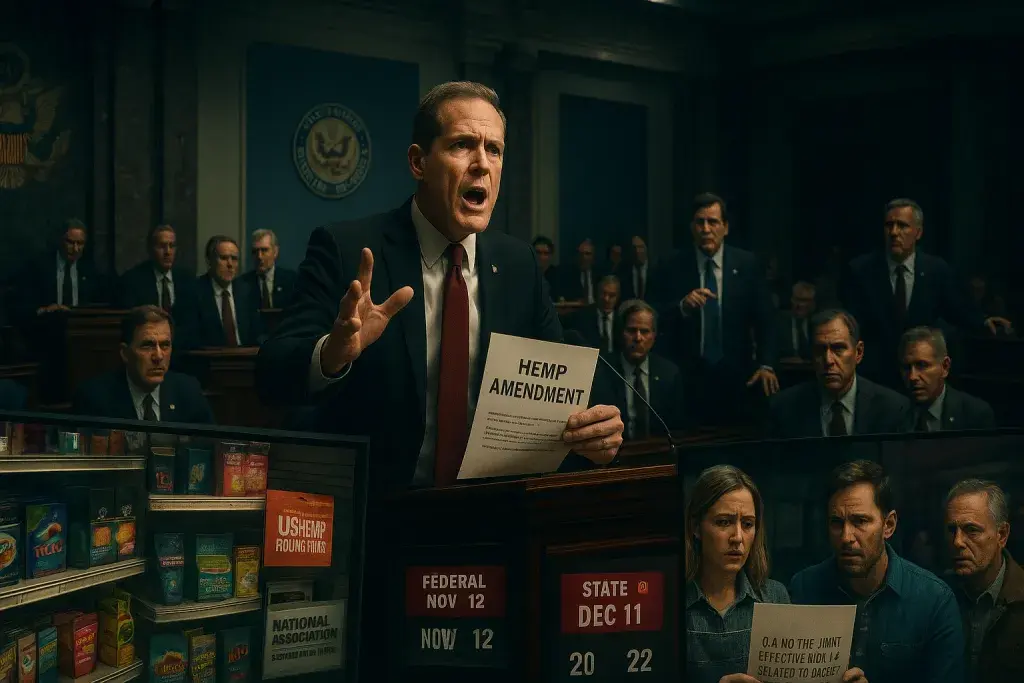
A month-long reprieve for intoxicating hemp products survived a Senate floor fight last week, but only after exposing deep fractures inside the Republican conference over how to handle a market that regulators, retailers, and now the White House can't agree on. Sen. Ted Budd, R-NC, tried to strip a delay provision from the chamber's continuing resolution that would have pushed the effective date of sweeping federal hemp restrictions from Nov. 12 back to Dec. 11. Senators voted 61-32 to table his amendment, meaning the delay stands - for now - while the underlying fight over what counts as legal hemp remains unresolved.
For dispensary operators, convenience store chains, and hemp brands operating outside traditional cannabis licensing, the stakes are direct and immediate. The federal law at issue redefines hemp to account for total THC and bars finished products containing more than 0.4 milligrams of combined THC and similar cannabinoids per container - a threshold that would wipe out most delta-8 vapes, THC beverages, and THCA flower currently sold in gas stations and smoke shops nationwide. Retailers who have built compliance systems around state-licensed cannabis, meanwhile, are watching this fight from a different vantage point, since many already operate under seed-to-sale tracking, COA requirements, and point-of-sale infrastructure built for a regulated market - the kind of operational backbone a platform like cannabis pos utah is designed to support in states where licensing is tighter and enforcement is active.
A Coalition Fight With Real Business Consequences
Budd framed his amendment around child safety, citing North Carolina emergency department data showing cannabis-coded visits among minors rose sharply between 2017 and 2025, and pointing to packaging that mimics popular snack and candy brands. That's a legitimate consumer-protection concern, and one regulators in licensed cannabis markets have wrestled with for years through mandatory child-resistant packaging and marketing restrictions. But the opposition to his amendment wasn't fringe. A coalition of 105 organizations - including the US Hemp Roundtable, the National Association of Convenience Stores, and several North Carolina hemp groups - argued the 30-day delay gives Congress room to write actual regulation: good manufacturing practices, import controls aimed at synthetic cannabinoids from China, and age restrictions, rather than a blunt THC cutoff that ends the market outright.
The administration's position adds another wrinkle. CMS Administrator Dr. Mehmet Oz warned that letting the broader restrictions take effect on schedule could disrupt recent efforts to expand access to full-spectrum hemp-derived CBD for seniors and people with disabilities - a claim Budd publicly disputed, asking why medical CBD access required keeping intoxicating products on convenience store shelves. Reports from a tense closed-door GOP lunch, where a White House aide reportedly told senators no further extension would be sought, suggest this delay is meant to be the last one. Operators banking on repeated postponements should plan otherwise.
North Carolina's Parallel Standoff
The federal drama has a mirror image in Raleigh, where House Bill 328 would import the same 0.4-milligram threshold directly into state law. The Senate approved the conference report 37-6 back in July, but the House has left it sitting in the Rules Committee, unable to reconcile law enforcement pressure with pushback from hemp business owners and consumers who favor age limits, testing, and labeling rules over what amounts to a near-total market shutdown. Speaker Destin Hall says lawmakers agree the current unregulated market can't continue but haven't settled on the fix.
What makes HB 328 notable for operators is that it would stand independent of whatever Congress ultimately does. Even if federal restrictions get delayed again, rewritten, or abandoned, North Carolina's own THC cap could still take effect on its own timeline. Retailers, distributors, and brands operating in hemp-derived cannabinoids should treat state and federal tracks as separate compliance risks, not one combined countdown clock.