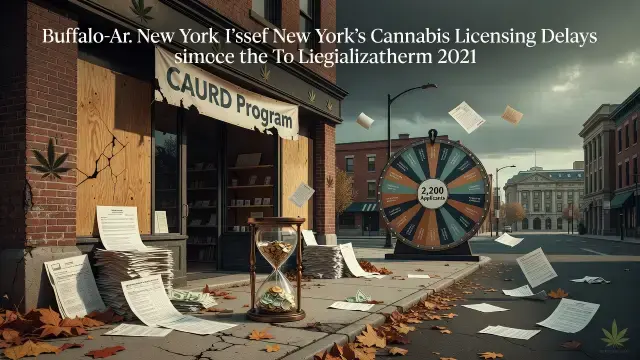
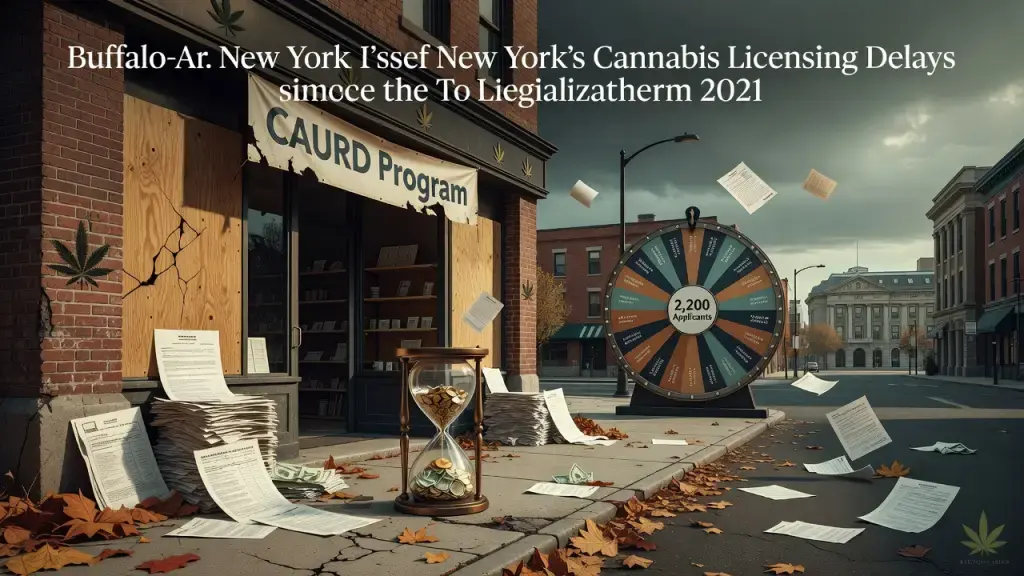
New York legalized adult-use cannabis in 2021. Five years later, operators are still learning that legalization and a functioning licensing system are not the same thing. One Buffalo-area dispensary owner's path from application to open storefront took years and roughly $100,000 in rent and legal fees on a location that sat empty the entire time - a cautionary tale other states should study before they launch their own adult-use markets.
A Conditional Program That Stalled Under Legal Challenge
New York's Conditional Adult-Use Retail Dispensary (CAURD) program was designed to get justice-involved entrepreneurs and qualifying nonprofits into the market first - a reasonable goal, given who bore the weight of prohibition-era enforcement. But good intentions don't automatically survive contact with litigation. An out-of-state applicant challenged the program's eligibility requirements, and the resulting injunction froze licensing in entire regions for months. Attorneys watching the program concluded it was being wound down quietly, with no formal announcement, leaving applicants to guess whether to stay the course or pivot to the general licensing round instead.
That's the real operational risk in a rollout like this: not just the policy itself, but the uncertainty around whether the policy will survive. Operators can plan around clear rules. They can't plan around rules that might evaporate.
Site Control Requirements Shift Risk Onto Applicants
New York's general licensing round required site control - meaning a signed lease on a qualifying storefront - before an application could even be queued for review. Then came a lottery to determine review order. Drawing a low position in a queue of roughly 2,200 applicants meant more waiting, more rent, and no revenue. This is where equity-focused licensing programs can undercut their own purpose: requiring a signed lease years before a predictable review date forces applicants to carry the entire financial burden of the state's processing timeline. For a program built around social equity, that is backwards. Conditional site approval, with a signed lease required only once a license is genuinely close, would shift that risk back toward where it belongs.
Paperwork Resets and Procedural Friction
Even after qualifying for review, minor administrative errors created real delays. A single incorrect digit on a municipal notification letter was enough to reset a 30-day review clock, pushing an application past a scheduled board meeting - and when the next meeting was canceled, the wait stretched further still. None of this involved a substantive compliance failure. It was paperwork friction, multiplied by a review process with little margin for correction.
Lessons for Markets Still Building Their Licensing Systems
States and countries now designing adult-use or social equity licensing programs have a chance to avoid repeating New York's missteps. A few principles stand out:
- Publish complete application requirements before any window opens, and hold them steady for the full round rather than amending them mid-process.
- Pressure-test equity eligibility criteria against likely legal challenges before applications open, not after a court injunction forces a scramble.
- Avoid requiring binding site control until a license is realistically close to approval, so applicants aren't paying rent on storefronts they can't yet legally open.
- Build grace periods into transitions between licensing tracks, so applicants who qualified under one program aren't penalized when that program changes or ends.
None of this diminishes the difficulty of what New York attempted. Balancing equity goals, zoning rules, tax structure, and legal exposure in a brand-new regulated market was never going to be simple. But the gap between legalizing cannabis and actually licensing retailers to sell it compliantly is where many markets lose credibility with the very entrepreneurs they claim to prioritize. For dispensary operators elsewhere, the lesson is straightforward: legal status on paper means little without a licensing process that is predictable, transparent, and financially survivable for the people trying to follow it.