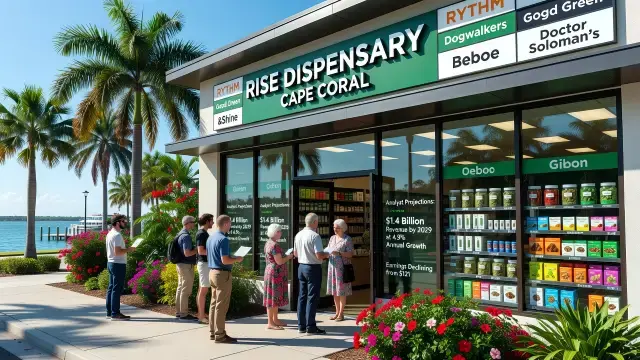
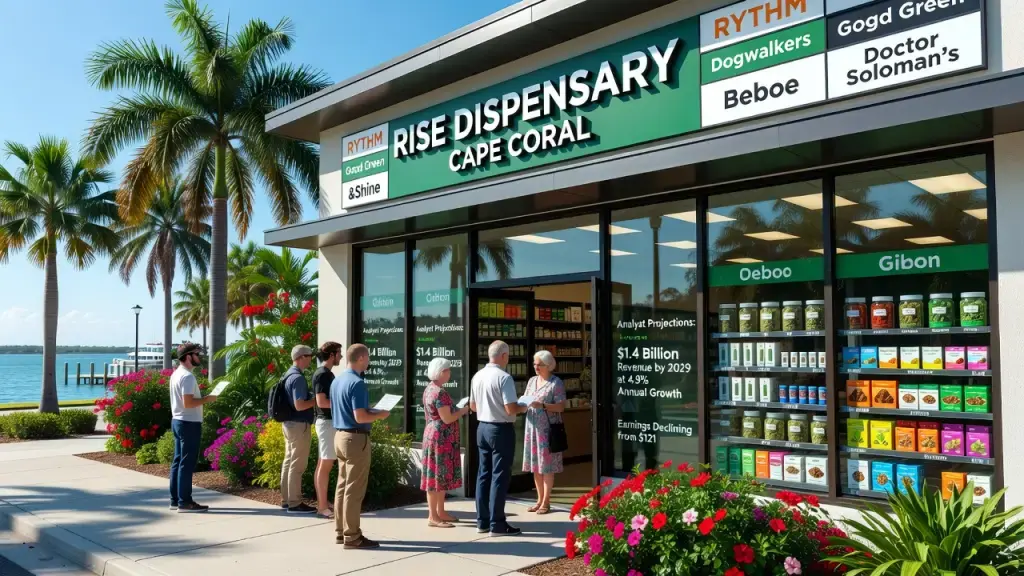
Green Thumb Industries opened RISE Dispensary Cape Coral on October 10, its 25th store in Florida and roughly its 120th across the country. The location gives the multi-state operator another retail foothold in Lee County's medical cannabis market, one more shelf for its house brands, and one more data point for investors trying to figure out whether store growth can outrun price compression.
Another Door, Same Underlying Math
Opening a new dispensary is the easy part, relatively speaking. The harder question is whether that store generates enough foot traffic and basket size to justify the capital behind it. Florida remains a medical-only market, which means age verification, physician certification, and patient registry checks sit at the center of every transaction - a different compliance posture than adult-use states, with its own staffing and point-of-sale requirements. Cape Coral adds throughput capacity for Green Thumb's vertically integrated model, where cultivation, processing, and retail all sit under one roof. That structure can help control wholesale costs, but it does not exempt the company from a retail environment where price per unit keeps sliding and patient acquisition costs keep climbing.
What The Brand Portfolio Gains, And What It Doesn't
RYTHM, Dogwalkers, Good Green, &Shine, Beboe and Doctor Solomon's now have another physical outlet to move product through. For the Consumer Packaged Goods side of the business, that matters only if sell-through stays healthy - new shelf space without matching demand just means more inventory sitting in the budroom. Dense medical markets like South Florida can support multiple SKUs per category, but they also invite internal cannibalization when an operator keeps adding its own stores close together. The real test is same-store sales, not store count.
The Numbers Behind The Expansion
Analyst projections tied to Green Thumb's broader narrative point to about $1.4 billion in revenue by 2029, built on roughly 4.9% annual growth, alongside earnings expected to fall from $121.2 million currently to around $22.9 million. That is a steep decline embedded in a growth story, and it reflects real pressure: rising SG&A, recently estimated near 38% of revenue in a forward quarter, flat revenue guidance in some periods, and continued exposure to wholesale partners whose balance sheets are not always strong. A more conservative view, predating the Cape Coral opening, still modeled $1.4 billion in revenue but landed on $49.1 million of earnings - treating even that lower number as optimistic. The spread between those two outcomes is the story analysts are actually arguing about.
Where The Real Risk Sits
Roughly $80 million in planned capital expenditure is tied to cultivation and retail buildout, including Florida, plus new footprints in adult-use markets such as Minnesota and possible regulatory shifts in Pennsylvania and Virginia. None of that spending pays off automatically.
- Price compression across wholesale and retail cannabis menus continues nationally, squeezing margin even where volume holds.
- Credit exposure to third-party retailers carrying Green Thumb products adds counterparty risk if those partners struggle financially.
- 280E tax treatment still limits standard business deductions for plant-touching operators, keeping effective tax burdens high regardless of store count.
- Seed-to-sale tracking and compliance recordkeeping costs rise with every additional license, adding fixed overhead that does not scale down easily.
Cape Coral is a reasonable, low-drama addition to a large retail network. Whether it moves the needle depends less on the ribbon-cutting and more on whether Green Thumb can hold margin while everyone else in the category keeps cutting price.