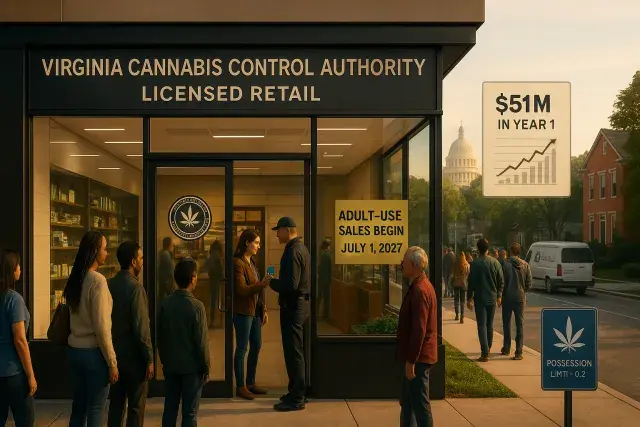
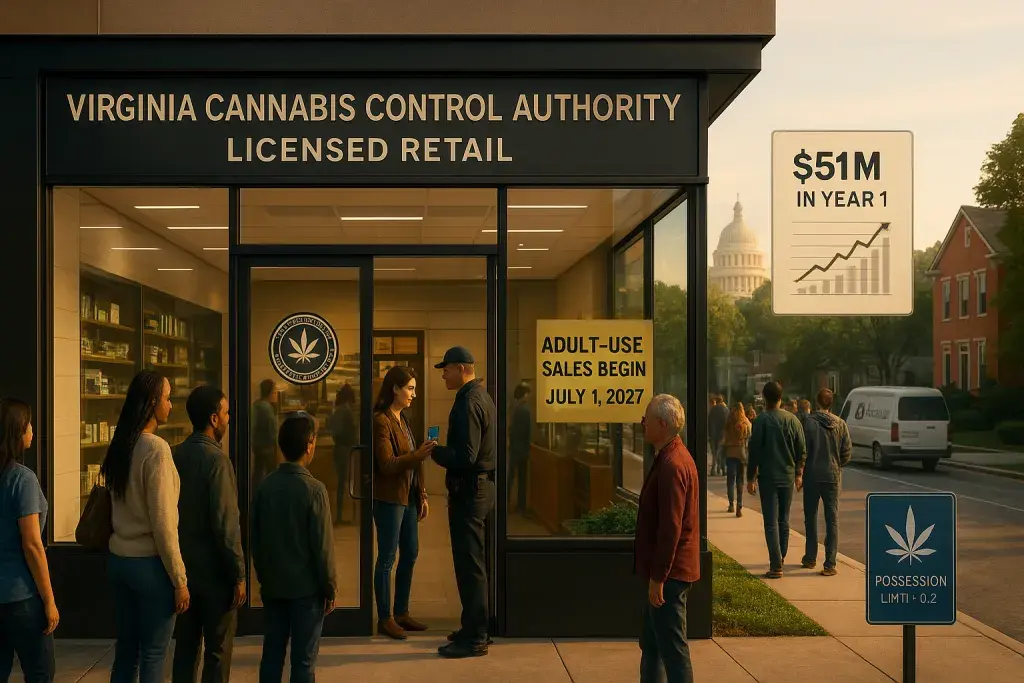
Virginia has cleared the final legislative hurdle to establish a regulated adult-use cannabis retail market - four years after legalizing possession but without giving licensed operators a legal channel to sell. State budget legislation enacted this week authorizes up to 350 licensed cannabis shops to begin selling to adults 21 and older starting July 1, 2027, with the state Cannabis Control Authority set to open its licensing application window on February 1 of that year. For operators, investors, and the suppliers already circling this market, the clock is now running.
The implications reach well beyond Virginia's borders. This is the first Southern state to build a regulated recreational retail framework, and that alone puts it on the radar for multi-state operators looking to expand into a region that has largely kept adult-use off the table. Operators entering this market will need their compliance infrastructure - seed-to-sale tracking, compliant packaging workflows, age-verification protocols, and a reliable IndicaOnline cannabis POS capable of handling both adult-use and medical transactions - built and tested well before the first retail day. Virginia already runs a medical cannabis program through licensed dispensaries, so some of the compliance scaffolding exists. But layering adult-use onto a functioning medical operation is not a straightforward switch.
What the Licensing Cap and Tax Structure Mean for Operators
The 350-license cap is not incidental - it's a deliberate market-sizing decision, and how the state allocates those licenses will shape competitive dynamics for years. Virginia's medical dispensary operators will likely position themselves for early adult-use licensing given their existing infrastructure and regulatory standing. That's a real advantage. But a capped license pool also means real scarcity, and anyone who has watched license-constrained markets in states like Illinois or Missouri knows that scarcity inflates entry costs, compresses wholesale margins, and creates pressure to open additional SKUs fast to justify build-out expenses.
On the tax side, Virginia will apply an excise tax on top of its existing sales tax. Legislative budget documents project the combined tax structure will generate roughly $51 million in state revenue during the program's first year. That figure gives operators a rough calibration point: the state is expecting meaningful volume, which implies it has modeled consumer demand at a level that justifies that revenue projection. In practice, though, operators should model their own unit economics carefully - excise tax stacks on top of cost of goods, and in markets where illicit operators undercut licensed retailers on price, thin margins get thinner fast. State Sen. Lashrecse Aird, who led the legislative push, acknowledged the illicit market problem directly, framing the regulated framework as a way to build a legal marketplace "affordable and accessible enough to actually compete."
The Equity Provisions - and the Compliance Risk Buried in Them
Virginia's path to this point was explicitly shaped by racial equity concerns. State data showing Black Virginians were disproportionately policed and prosecuted for marijuana-related offenses drove Democratic legislative strategy for years. The new law increases the adult possession limit from one ounce to two ounces and preserves home cultivation rights - both provisions with direct implications for how operators communicate with consumers about legal boundaries.
Here's the catch: the legislation also raises the civil fine for public consumption, a provision that drew criticism from advocacy groups who argued it risks replicating the same disproportionate enforcement patterns the legalization effort was designed to address. For dispensary operators, that tension matters operationally. Responsible retailing means staff training on consumption rules, clear point-of-sale messaging about where legal consumption is and is not permitted, and documented compliance logs that show the business is not contributing to public-consumption incidents near the storefront. These aren't abstract concerns - they show up in license renewal reviews and local zoning negotiations.
A Regional Outlier With National Timing
Virginia's move lands at an unusual moment in federal cannabis policy. The Trump administration announced in April that it was reclassifying state-licensed medical marijuana as a less dangerous controlled substance and indicated it was accelerating the broader reclassification process. That doesn't legalize recreational cannabis federally - not even close - but it creates a regulatory environment slightly less hostile to banking access, which remains the central operational pain point for licensed cannabis retailers. Cashless payment workarounds, cash-heavy operations, and 280E tax exposure under the federal controlled-substance classification are still the daily reality for most dispensary operators. Virginia's operators will enter that same environment.
What's striking about Virginia's timeline is the distance between now and the July 2027 retail start date. That's not a short runway. It gives prospective licensees time to build out compliant retail spaces, establish wholesale supplier relationships, negotiate with payment processors, and prepare inventory management systems for dual medical-and-adult-use environments. It also gives regulators time to write the detailed rules that will govern product testing requirements, labeling standards, and delivery operations - details that will determine day-to-day compliance burdens more than the headline legislation does. Operators who wait for those rules to finalize before planning are the ones who will be scrambling. The ones watching the regulatory docket now will be ready.