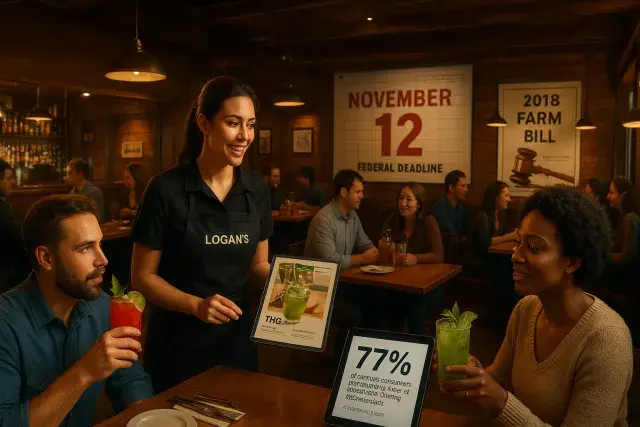
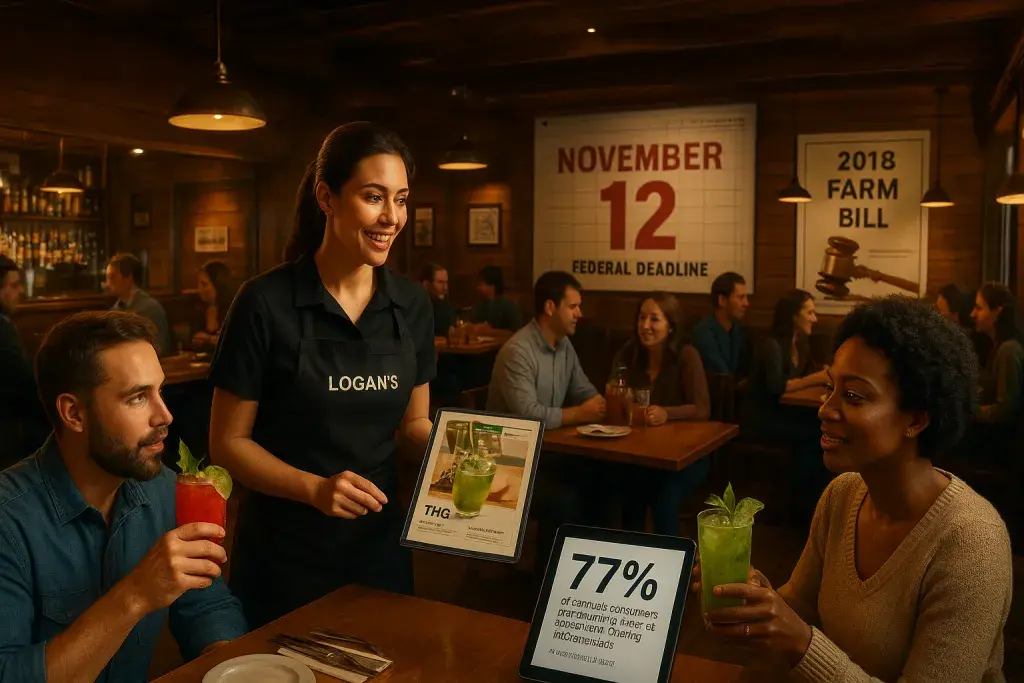
Seventy-seven percent of cannabis consumers in state-legal markets say they are more likely - much more likely or somewhat more likely - to dine at a restaurant that offers hemp-derived THC beverages as an alcohol alternative, according to a new poll from cannabis telehealth platform NuggMD. The survey, conducted June 18-21 among 873 cannabis consumers, carries a margin of error of 3.32 percentage points. The timing matters: the restaurant industry is actively testing the format, and a federal deadline that could pull these products from shelves and menus is now less than six months away.
For operators tracking where consumer dollars are moving, the signal here is hard to ignore. The food-and-beverage sector is already acting on it - Texas steakhouse chain Logan's Roadhouse recently announced it would test three THC-infused cocktails across 14 locations, a move that reflects both consumer appetite and the relatively straightforward economics of beverage service. Cannabis beverages, particularly hemp-derived THC drinks that currently sit in a legal gray zone under federal law, carry margins that Andrew Graham, NuggMD's head of communications, compared to liquor. For dispensary operators watching adjacent retail channels absorb cannabis-adjacent revenue, that comparison deserves attention. The beverage format also sidesteps several compliance barriers that have historically made on-site cannabis consumption difficult to structure - and operators considering multi-format retail, from licensed dispensaries to social consumption spaces, would do well to monitor how point-of-sale infrastructure handles THC beverage transactions in regulated markets. A New Jersey dispensary POS platform, for instance, must already account for age verification, purchase limits, and product-type tracking across SKUs - the same compliance architecture that any food-and-beverage venue entering this space would eventually need to build out.
The Regulatory Ceiling Sitting Over This Market
Here's the catch. The hemp-derived THC beverages driving this consumer enthusiasm are products that exist, legally, because of the 2018 Farm Bill's definition of hemp - specifically, that derivatives with less than 0.3 percent delta-9 THC on a dry-weight basis are federally lawful. Late last year, Congress passed and President Trump signed legislation that redefines that threshold dramatically: after November 12, only products containing 0.4 milligrams of total THC per container will remain federally legal. That is not a typo. A single standard THC beverage serving of 5 milligrams would be illegal under the new threshold. The National Restaurant Association has sent a letter to congressional leaders asking them to delay that deadline and replace it with a workable regulatory framework. The hemp industry is in an analogous position to what cannabis operators faced pre-legalization: a product with demonstrated consumer demand and active commercial infrastructure that could be federally prohibited overnight.
Rep. Beth Van Duyne (R-TX) is circulating draft legislation - the Hemp-Derived Beverage Regulatory Clarity Act - that would carve out hemp THC beverages from the broader recriminalization. In its current form, the bill would permit adults 21 and over to purchase drinks containing up to 5 milligrams of delta-9 THC per serving and would impose a federal tax of 10 cents per milligram of any hemp-derived cannabinoid in such beverages. That tax structure is worth noting for any operator modeling the economics of THC beverage programs: excise tax layered onto a per-milligram basis adds cost complexity that differs from how most cannabis retail excise frameworks are currently structured at the state level.
The White House Position - And Why It's Still Unclear
The Trump administration has made its general direction plain. The president posted on Truth Social in April urging Congress to act on hemp recriminalization, specifically citing consumer access to full-spectrum CBD products and the downstream impact on American farmers - a segment whose hemp crop value grew 64 percent year-over-year to approximately $750 million in 2025, according to a USDA report published in April. White House OMB Director Russell Vought followed with a letter to House Speaker Mike Johnson expressing the administration's desire to "ensure the fair treatment of hemp products." The Centers for Medicare & Medicaid Services separately launched a program allowing eligible Medicare patients up to $500 annually in hemp-derived products, with allowances for products containing up to 3 milligrams of total THC per serving.
What the administration has not done is specify exactly where it wants the line drawn on intoxicating hemp THC products - as distinct from full-spectrum CBD. That ambiguity leaves the beverage category in a genuinely uncertain position. The White House has signaled it wants a fix; it has not confirmed that the 5-milligram-per-serving framework in Van Duyne's draft bill, or anything close to it, has administration backing. Several congressional amendments aimed at preserving hemp product legality were blocked or withdrawn in recent House procedural maneuvering, which tells you something about how much friction remains even among lawmakers nominally aligned on the issue.
What Operators and Brands Should Watch
The NuggMD data reinforces what the market was already showing behaviorally: consumers in state-legal cannabis markets view THC beverages as a social consumption format, not just a home-use product. A separate NuggMD poll found meaningful consumer interest in dispensaries that function as cafes, social clubs, or wellness spaces - the same instinct that is pulling restaurants toward THC drink menus. For licensed cannabis operators, this represents both a competitive dynamic and a potential opportunity, depending on how state law treats co-location of cannabis retail and food service.
The compliance picture, though, is genuinely messy right now. Hemp-derived THC beverages and state-licensed cannabis products occupy different regulatory tracks - different testing standards, different labeling requirements, different distribution chains, different tax treatment. A restaurant adding hemp THC cocktails to its menu is not operating under the same framework as a licensed dispensary selling ingestible cannabis products, even if the consumer experience looks similar. If the November deadline arrives without a congressional fix, every restaurant, retailer, and distributor carrying hemp THC beverages faces abrupt removal of product from inventory - an operational and financial disruption that has no clean analog in standard retail. Operators across both the hemp and licensed cannabis sectors should be treating November 12 as a hard planning date, not a background political story.