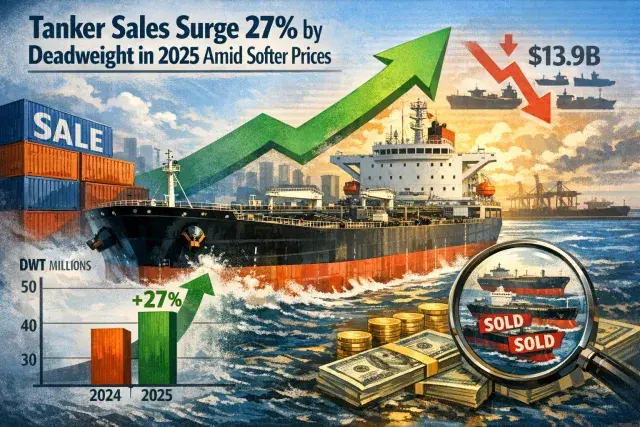
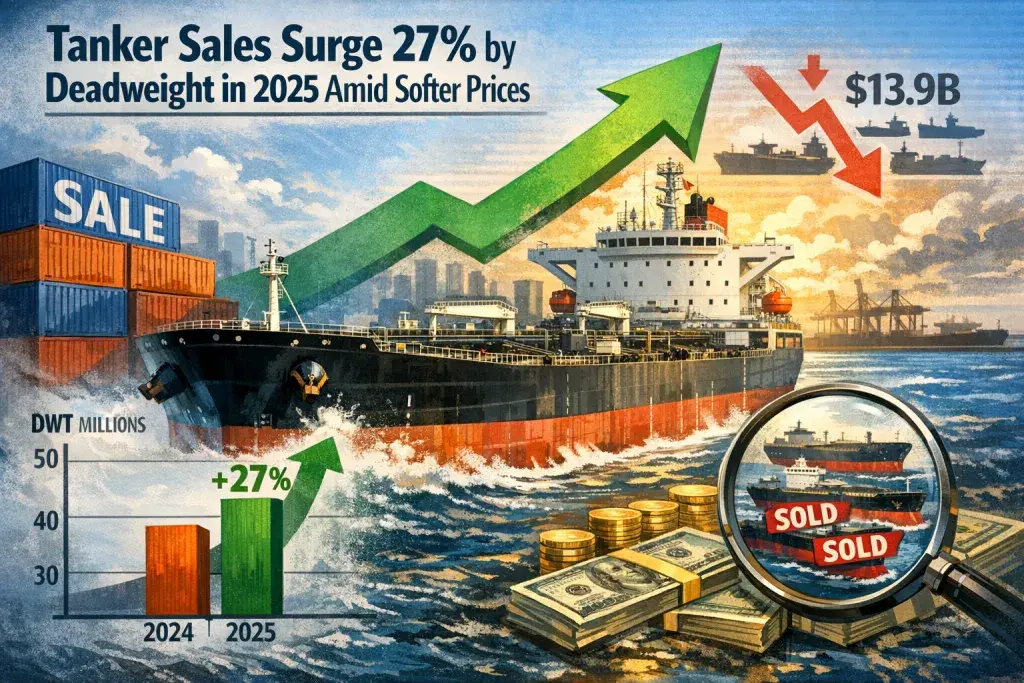
Sale and purchase activity in the tanker market has accelerated sharply this year, with Clarksons Research logging 409 vessels totaling 44.5 million deadweight tons (dwt) and $13.9 billion in transactions through late 2025. This marks a 27% increase in dwt terms over the 2024 run rate, though dollar volume rose only 3% due to declining secondhand prices. The divergence signals robust demand for tonnage despite valuation pressures, a dynamic that underscores broader shipping market resilience.
Tankers Lead with Steady Demand, Price Recovery
Clarksons' five-year-old tanker secondhand price index averaged 10% lower in 2025 than in 2024, yet levels have climbed 5% since September, hinting at stabilizing conditions. VesselsValue data for December shows tanker values holding firm across sectors, with very large crude carriers (VLCCs) posting the strongest gains: 20-year-old 310,000 dwt units rose 7.27% month-on-month to $43.21 million, driven by scarcity of compliant older vessels amid tightening supply regulations.
Key deals reflect this appetite. NYK sold the 19-year-old VLCC Towada for $45.7 million, while Cido Shipping offloaded the 14-year-old sister VLCCs Mermaid Hope and Mercury Hope en bloc for $120 million. Such transactions highlight buyers targeting middle-aged assets to bridge gaps in eco-compliant fleets, where newbuild delays and retrofit costs inflate premiums for ready tonnage.
Bulk Carriers Lag Despite Strong Freight Support
Bulk carrier sales cooled in early December, with only 14 vessels traded despite firm freight rates and time charter support. Values stayed stable, but capesize ships led gains, as 20-year-old 180,000 dwt units advanced 5.42% to $19.06 million since month-start, per VesselsValue. This uptick in older capesizes mirrors tanker trends, where owners capitalize on elevated earnings before potential oversupply hits.
Notable moves include NGM Shipping's sale of the 14-year-old Japanese-built Pacifist capesize for $32 million—a vessel acquired five years prior for about $19 million, yielding substantial gains amid prolonged high rates. NYK Bulkship also divested the 2012-built 107,000 dwt NBA Rembrandt for $18.7 million, reportedly to ArcelorMittal Shipping, following the similar sale of sistership NBA Rubens in September for around $15 million. These flips demonstrate opportunistic plays in a market where capesize strength offsets slower overall S&P pace.
Containers Hold Firm in Charter Strength
Container ship sales mirror charter market stability, elevated 35% above 2024's one-year time charter average, even as global 40ft container rates plunged 45% year-over-year per Drewry. Alphaliner notes a "cheerful mood" closing 2025, with demand persisting across sizes and prices firm. A prime example: the middle-aged 8,568 teu sister ships Cypress, Koi, and Lotus A sold en bloc to Global Ship Lease for $90 million, backed by a time charter to CMA CGM.
These patterns point to selective buying in assets generating reliable income, insulating owners from spot rate volatility. Across sectors, the 2025 S&P surge—especially in tonnage volume—suggests shipping firms position for 2026 uncertainties, including fuel transition mandates and geopolitical supply risks, favoring proven vessels over speculative newbuilds.