At the Planet MicroCap Showcase in Toronto on Wednesday, NewLake Capital Partners made a pitch that has become familiar to anyone tracking cannabis-adjacent real estate investment trusts: the properties are leased, the rent is coming in, and the stock price doesn't reflect it. Chief Executive Anthony Coniglio framed the company's model in plain terms - buy cannabis real estate, lease it to operators, collect rent, pay a dividend - and argued that the gap between NewLake's fundamentals and its market valuation has little to do with the business itself.
A Portfolio Built for Duration, Not Speed
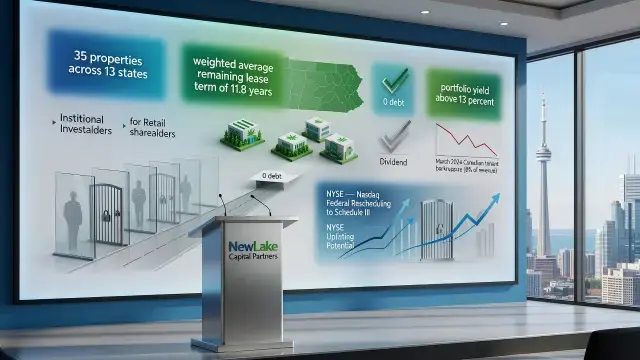
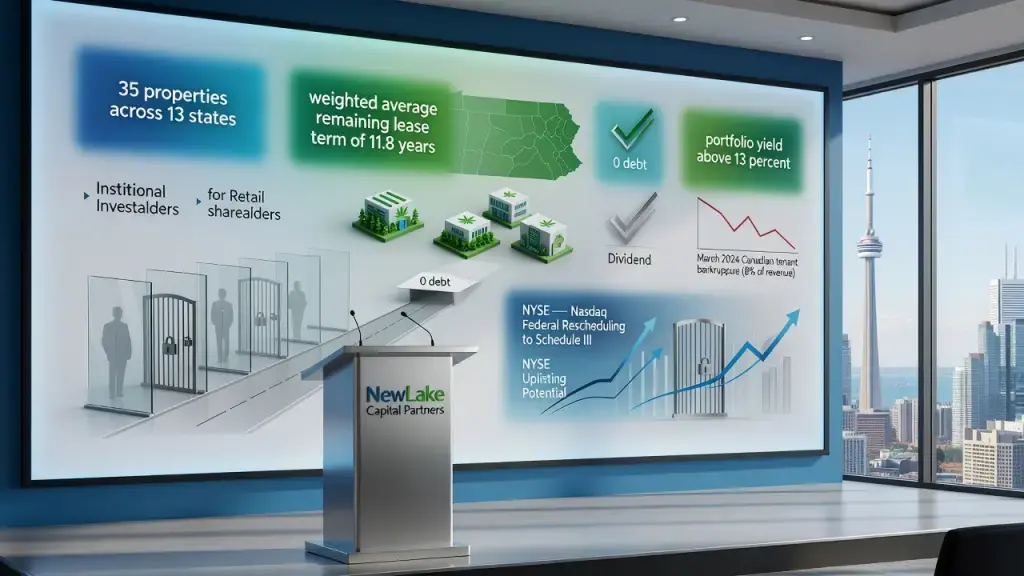
NewLake's 35 properties span 13 states and 12 tenants, with 32 currently leased and three available. That's a small footprint compared with sprawling multi-state operator real estate books, but the company's pitch isn't about size. It's about duration and discipline. A weighted average remaining lease term of 11.8 years, paired with 2.6% annual rent escalators, gives the REIT a cash flow profile that looks more like conventional net lease real estate than the volatile plant-touching side of the industry. Portfolio yield on invested capital in leased properties runs above 13%, and the EBITDAR coverage ratio sits at 3.9x - a figure management says holds up against non-cannabis REIT peers.
The tenant roster leans on scale operators: Curaleaf, Cresco Labs and Trulieve top the list. That concentration cuts both ways. It signals confidence in companies with national footprints and compliance infrastructure, but it also means NewLake's revenue is exposed to the financial health of a handful of multi-state operators rather than a broad, diversified base. One tenant's March 2024 bankruptcy filing in Canada, representing 8% of revenue, is the clearest illustration. Rent has kept coming monthly through an asset sale process, but the episode is a reminder that even triple-net cannabis leases carry counterparty risk that traditional retail landlords rarely face.
Zero Debt, an 88% Payout Ratio, and the Case for Dividend Durability
NewLake's balance sheet has no debt outstanding, down from a peak of $7.5 million, and its $90 million credit facility was recently extended to 2029 at a cost 100 basis points lower than before. That's a meaningful signal in a sector where banking access remains constrained by federal law and where many operators still pay cash-intensive tax bills under IRC 280E. An 88% AFFO payout ratio, within the company's stated 80% to 90% target range, leaves a cushion for the $0.43 quarterly dividend. Management said even a worst-case scenario involving the bankrupt tenant's properties would still leave a 3% to 4% dividend cushion - not a wide margin, but not razor-thin either.
The company's growth playbook is narrow by design: rent escalators, tenant improvement capital on existing deals, leasing the three vacant properties, and new transactions as the market stabilizes. Coniglio was explicit that NewLake isn't chasing growth for its own sake, a posture that reads as conservative in a sector still working through oversupply and price compression in less-restricted license states.
Custody Rules, Not Fundamentals, as the Stated Constraint
The sharpest part of Coniglio's presentation centered on why the stock trades where it does. Because NewLake isn't listed on the NYSE or Nasdaq, many custody agents won't hold the shares for institutional clients - a structural limitation, not a judgment on the business. That leaves the company with more than 12,000 retail shareholders and, according to Coniglio, institutional investors who understand the story but can't act on it. He described the post-2021 period as "the great unwind," when forced institutional exits compressed the valuation further.
Federal rescheduling is the hinge point. The DEA's move to Schedule III in April 2024 created federal legality for roughly half of NewLake's portfolio, according to management, and an administrative law judge hearing on broader all-plant rescheduling wrapped in July 2024. Management's estimate is that the process concludes in late 2025 or early 2026 - though Coniglio noted a 1988 precedent where the DEA retained Schedule I status despite a judge's recommendation otherwise, a caution against assuming the outcome is settled. If rescheduling clears and an uplisting follows, NewLake says it already meets New York and Nasdaq listing standards and would apply immediately.
What the Hemp Shift and License Caps Mean for Tenants
Management also pointed to the restriction on intoxicating hemp products, tied to a law signed in November 2023, as a tailwind for state-licensed operators. Coniglio cited Ohio's experience after a synthetic hemp ban, where state-legal sales reportedly rose, as an early signal that regulated channels could capture demand previously lost to unregulated hemp-derived THC products. For dispensary operators and brands competing against gas-station hemp beverages and edibles, that kind of enforcement matters more than any single real estate transaction.
NewLake's preference for limited-license states - Pennsylvania's 33 licenses versus the comparatively open markets in Oregon and Washington - reflects a broader lesson for the industry: license scarcity supports margin, and oversupply erodes it. For landlords, wholesalers and multi-state operators alike, that distinction increasingly shapes where capital flows and where it doesn't.