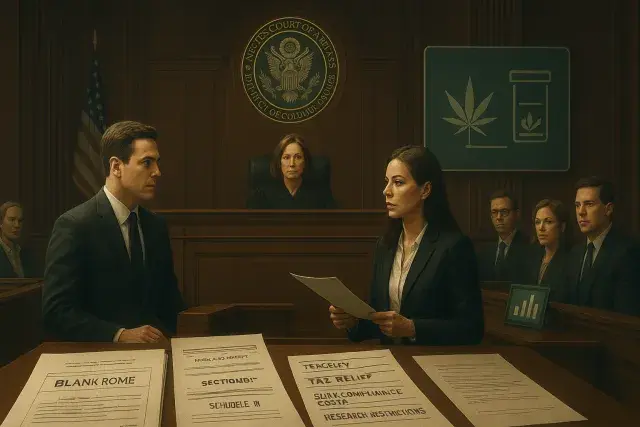
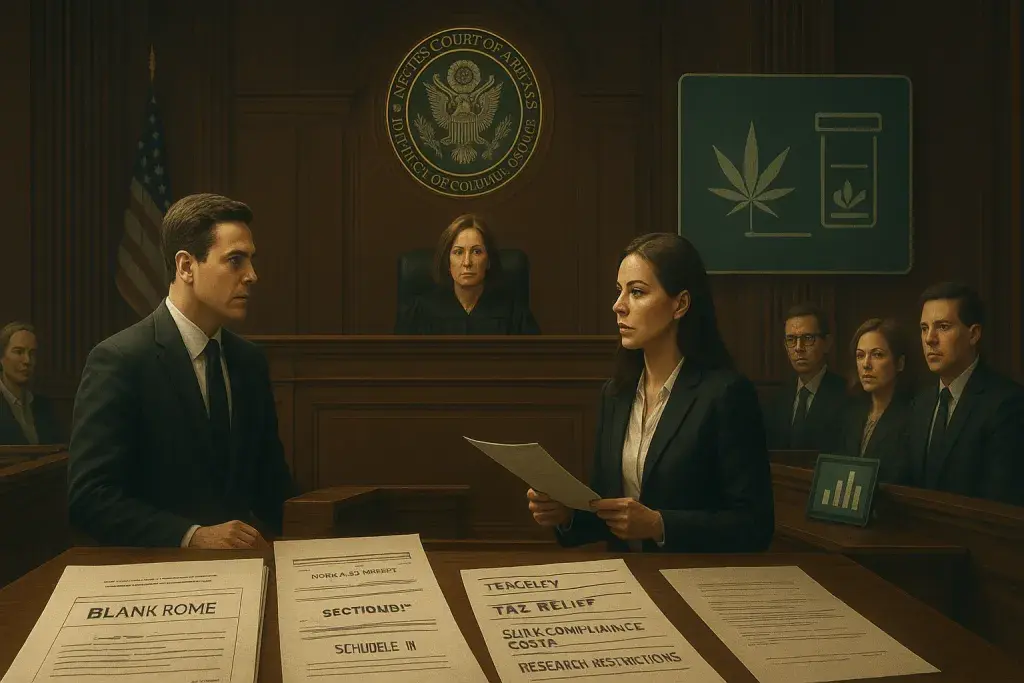
Two state-licensed medical cannabis companies have filed a motion to intervene in consolidated federal lawsuits seeking to block marijuana rescheduling, aligning themselves with the Department of Justice against prohibitionist challengers. MedPharm Iowa, LLC-operating as Bud & Mary's-and Pennsylvania-based Tri-Mountain Pure, LLC argue they face direct, concrete harm if opponents of the reform succeed in vacating the federal order that moved certain cannabis products from Schedule I to Schedule III of the Controlled Substances Act. The motion, filed Monday in the U.S. Court of Appeals for the D.C. Circuit, marks one of the first instances of private cannabis businesses formally entering the legal defense of rescheduling.
The stakes here are not abstract. Both companies have already applied for DEA registration under a form the agency made available to cannabis businesses following the rescheduling action-an administrative step that carries real compliance and planning weight for any licensed operator. For context on how state-by-state regulatory structures shape the business environment for medical operators, read more on how licensed markets function at the retail level. The motion's argument is straightforward: these businesses have committed resources, made operational decisions, and filed federal paperwork based on the expectation that Schedule III status would hold. Unwinding that now would not be a technicality-it would be a financial and operational setback with measurable consequences.
Five Pressure Points - and Why They Matter to the Industry
The motion lays out five distinct categories of harm, and each one maps directly to problems that cannabis operators across the country already manage daily. The most immediate is tax liability. Under Section 280E of the Internal Revenue Code, businesses that traffic in Schedule I or Schedule II controlled substances cannot deduct ordinary business expenses-payroll, rent, cost of goods, marketing, compliance software, you name it. That restriction has long imposed an effective tax rate on cannabis operators that bears no resemblance to what a comparably sized business in any other regulated industry would face. Schedule III status removes that burden. A reversion to Schedule I would snap it back into place, and for operators with thin margins, that difference is not academic.
The second harm is the loss of pending DEA registrations and the sunk compliance costs attached to them. That language-"sunk compliance costs"-deserves attention. Licensed cannabis businesses spend heavily on regulatory preparation: legal fees, internal audits, third-party compliance reviews, documentation systems. When the regulatory ground shifts and that spending yields nothing, there is no mechanism to recover it. The motion makes this point explicitly, noting that the companies would be forced to "postpone or abandon planned initiatives" and "absorb" those costs. That is a real operational risk, not a theoretical one.
The remaining three harms-research restrictions, commercial relationship barriers, and talent recruitment challenges-reflect structural problems that have plagued the licensed cannabis industry since state programs first launched. Schedule I status limits clinical collaboration, restricts institutional research partnerships, and creates friction with financial counterparties including banks, insurers, payment processors, and commercial vendors. The banking point alone is significant. Even with incremental progress in cannabis banking access over recent years, Schedule I classification has kept many mainstream financial institutions on the sideline or charging premium rates for basic services. The talent problem is real too. Pharmacists, scientists, and executives with professional licensing boards to answer to have had legitimate reasons to hesitate before joining a Schedule I cannabis business. Schedule III doesn't resolve every concern in that conversation, but it changes the legal context in ways that matter to qualified candidates weighing their options.
Why the Companies Say DOJ Can't Represent Them Alone
The motion's legal theory on this point is worth understanding on its own terms. The companies argue that the Department of Justice, as a government agency, will defend rescheduling based on institutional interests and legal authority-not based on the private commercial stakes of state-licensed operators. That distinction matters in intervention jurisprudence: to justify joining as a party, an intervenor typically must show that existing parties cannot adequately represent their specific interests. Here, the argument is that DOJ's defense of the rescheduling order will focus on administrative procedure, agency authority, and regulatory process-while Bud & Mary's and Tri-Mountain Pure have a narrower, more concrete interest in the specific outcome: preserving their DEA registrations, their Schedule III tax treatment, and the commercial relationships they've built around the expectation of federal reform.
The filing was prepared by attorneys at Blank Rome LLP, and the argument is well-framed for the purpose. Whether the court grants the intervention is a separate question, but the legal logic is grounded in standard intervention doctrine rather than a novel theory.
The Broader Legal and Regulatory Picture
The litigation these companies are entering involves three consolidated challenges from anti-rescheduling plaintiffs. One is led by Smart Approaches to Marijuana and the National Drug and Alcohol Screening Association. A second was brought by a coalition of anti-marijuana advocates, substance misuse professionals, and a cannabis-focused biopharmaceutical company. The third was filed by the attorneys general of Indiana, Nebraska, and Louisiana-though Louisiana has since withdrawn. The SAM-led litigation was filed with legal support from a firm where former Attorney General William Barr is a partner-the same Barr who led DOJ during President Trump's first term. That is an irony the industry has not missed.
Separately, the House Appropriations Committee voted to block federal officials from advancing rescheduling further-though bipartisan lawmakers have indicated they don't expect that legislative effort to ultimately succeed. And at the administrative level, DEA hearings are currently proceeding on the broader rescheduling question, with government witnesses addressing cannabis's medical uses and relative safety while opponents challenge the procedural basis for the reform.
What's striking here is the alignment. A Republican administration's DOJ is defending cannabis rescheduling. State-licensed medical marijuana operators are filing to join that defense. Former Republican law enforcement officials are leading the opposition. The lines don't fall where they once did, and for cannabis businesses trying to plan operations, hire staff, and manage compliance across multiple jurisdictions, that instability in the federal posture is its own kind of operational risk-regardless of how the litigation eventually resolves.