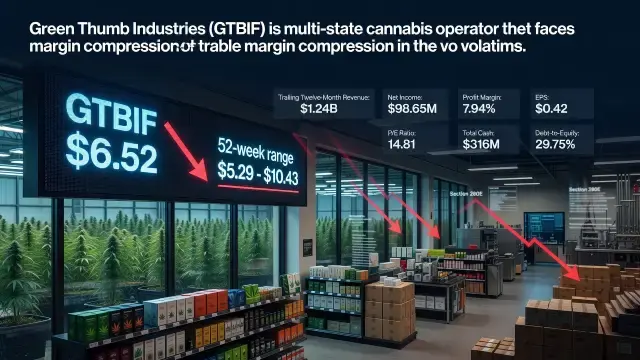
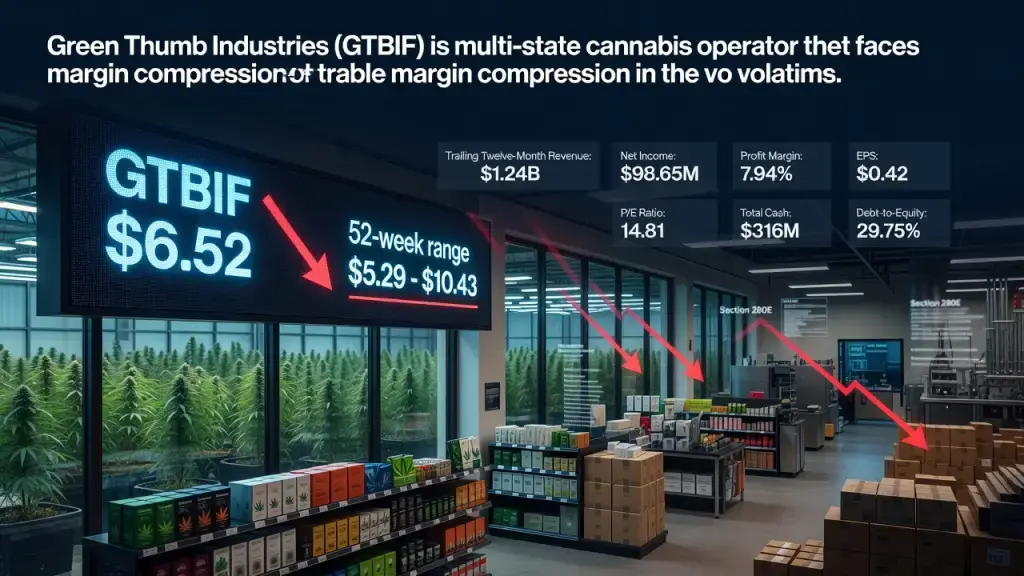
Green Thumb Industries (GTBIF) is trading well off its 52-week high, with shares recently changing hands around $6.52 against a 52-week range of $5.29 to $10.43. That's a steep pullback for one of the cannabis sector's steadier multi-state operators, and it raises a question that applies across the industry right now: how much of this is company-specific, and how much reflects the broader squeeze on licensed cannabis retail?
What the Numbers Actually Say
The headline figures aren't disastrous. Green Thumb posted trailing twelve-month revenue of $1.24 billion, net income available to common shareholders of $98.65 million, and a profit margin of 7.94%. A trailing P/E of 14.81 isn't expensive by conventional retail standards. Return on equity sits at a modest 5.13%, and return on assets at 2.39% - numbers that suggest a profitable but capital-heavy business, which tracks with how vertically integrated cannabis operators are built. Owning cultivation, processing, and dispensary doors outright means carrying real estate, build-out costs, and compliance infrastructure that a pure retailer wouldn't.
Total debt-to-equity of 29.75% is reasonably conservative for the space, and $316 million in cash on hand gives the company room to maneuver. Levered free cash flow of $140.65 million is arguably the more telling figure here - it's the number that determines whether a multi-state operator can keep opening stores, retrofitting POS systems for compliance updates, and absorbing state-by-state tax bills without leaning on dilutive financing.
Why 280E Still Shapes Every Earnings Call
Here's the catch that never goes away for any plant-touching cannabis business, Green Thumb included: Section 280E of the federal tax code still disallows standard business expense deductions because cannabis remains federally scheduled. That means a profit margin that looks respectable on paper is often thinner once the effective tax burden is accounted for. Investors parsing a PE ratio of 14.81 should keep in mind that it sits on top of a tax structure no ordinary retailer faces. This is the mechanism that keeps cannabis operators from trading at multiples comparable to conventional consumer-packaged-goods companies, no matter how clean the balance sheet looks.
It also explains why operators like Green Thumb lean so heavily on vertical integration and wholesale distribution to brands and third-party dispensary menus. Controlling more of the supply chain - cultivation, extraction, compliant packaging, and retail - is one of the few levers available to offset a tax code that otherwise erodes margin at every stage.
What a Falling Stock Price Means for the Retail Floor
A publicly traded operator's share price isn't just a finance-page curiosity; it filters down to store-level decisions. Lower market capitalization - currently $1.364 billion - can tighten access to capital markets, which in turn affects how aggressively a company expands dispensary footprints, upgrades seed-to-sale tracking systems, or invests in cashless payment infrastructure that keeps budroom transactions compliant with banking restrictions still tied to federal illegality.
For wholesale partners and brands selling into Green Thumb's retail network, a cautious capital environment often means slower payment terms and more conservative purchase orders. For landlords and suppliers, it's a reminder that cannabis retail economics remain sensitive to financing conditions in ways that conventional retail categories generally are not.
- 52-week trading range: $5.29 to $10.43
- Trailing P/E ratio: 14.81, with EPS (TTM) of $0.42
- Revenue (TTM): $1.24 billion; net income avi to common: $98.65 million
- Total cash (MRQ): $316 million; debt-to-equity: 29.75%
- Average 1-year analyst price target: $14.50, well above current trading levels
That gap between the current share price and the $14.50 average analyst target is notable, though not unusual in a sector still working through regulatory uncertainty, state-by-state licensing disparities, and the long wait for federal rescheduling or banking reform. None of that changes the day-to-day reality for operators: compliance logs still need auditing, lab testing and COA documentation still gate every product batch, and tax bills still arrive regardless of where the stock trades.