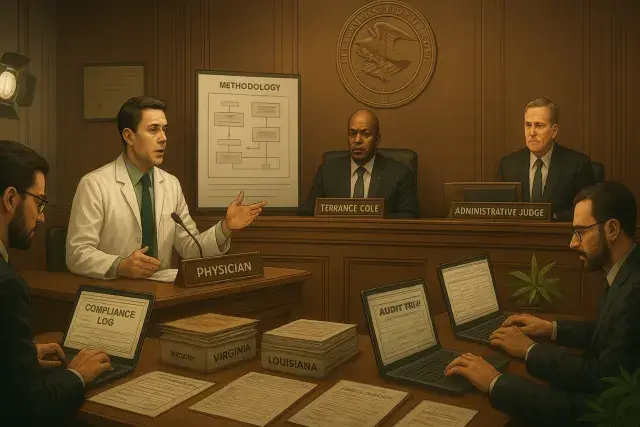
The Drug Enforcement Administration's long-anticipated administrative hearing on cannabis rescheduling begins Monday - and the agency's own witness list reveals just how much the government's case leans on medical legitimacy and procedural credibility. A physician is slated to testify that medical marijuana provides a medical benefit to pain patients and to describe patient safety measures used in the licensed industry. An FDA official will walk the hearing through the methodology behind the agency's original rescheduling recommendation. That's the government's opening hand.
For licensed operators - the dispensary owners managing compliance logs, the multistate operators tracking SKU-level inventory across METRC, the POS vendors building out audit trails - the hearing's outcome carries direct business consequences. A move from Schedule I to Schedule III would not, by itself, legalize adult-use cannabis or change state licensing structures, but it would alter the federal tax treatment that has squeezed operator margins for years. Under Section 280E of the Internal Revenue Code, cannabis businesses currently cannot deduct ordinary business expenses because they are classified as trafficking a Schedule I or II substance. Rescheduling to Schedule III could eliminate that restriction, meaningfully improving the economics of licensed retail. Operators in states like Maryland, where regulated adult-use sales are relatively recent and compliance infrastructure is still maturing, are watching this closely - and tools like this dispensary POS are part of the compliance architecture that stands to be reshaped by whatever regulatory framework emerges from the federal level.
Here's the catch, though: the hearing is not a public proceeding in any conventional sense. The DEA has made clear it does not intend to invite supportive advocacy organizations to participate. The agency judge overseeing the proceedings has declined to consider filings from non-parties. That posture has drawn pushback - Marijuana Moment escalated its livestream request directly to DEA Administrator Terrance Cole after hitting that wall, and it was joined by Rep. Steve Cohen (D-TN), Law360, a New York Times reporter, Cultivated Media, and medical cannabis advocates. The transparency question is not academic. Administrative hearings of this magnitude, touching an industry that employs hundreds of thousands of people and operates under an unusually restrictive compliance regime, carry real public-interest weight.
Opposition Briefs Signal a Contentious Process
Marijuana reform opponents - including three states that filed new briefs ahead of the hearing - are previewing arguments against rescheduling that range from public health concerns to procedural objections about how the FDA developed its recommendation. That's a meaningful development. State-level opposition reflects a real tension in cannabis policy: some states have built regulatory and revenue frameworks on the current federal prohibition status, and rescheduling introduces variables their agencies haven't fully mapped. The DEA's own request that the DOJ Office of the Inspector General conduct an independent review of separate allegations - that the agency allowed fentanyl pills to reach the streets - adds a layer of institutional complexity to an already pressured hearing environment.
State-Level Moves Keep the Policy Map Shifting
While the federal hearing dominates the headline, state legislatures and governors are not standing still. Virginia Gov. Abigail Spanberger submitted budget amendments that include provisions to legalize recreational marijuana sales, though she left the cannabis sections unchanged - a signal of strategic restraint as lawmakers prepare to vote. Louisiana Gov. Jeff Landry allowed a psychedelic-assisted therapy pilot program to take effect without his signature, funded by opioid settlement dollars and targeting clinical development of psilocybin, ibogaine, and MDMA as alternative treatments. That's a notable policy move, even if the governor's non-signature communicates ambivalence rather than endorsement.
South Carolina's lawmakers failed to agree on restrictions for hemp-derived THC products, which means those products remain broadly legal in the state - a reminder that the hemp and cannabis regulatory boundary is still contested territory in much of the country. Meanwhile, Missouri is opening a third round of microbusiness license applications, California regulators announced a product recall tied to incomplete and incorrect compliance testing, and Rep. Dina Titus (D-NV) introduced the SAFE Banking Act again, citing an industry of over 400,000 employed Americans still locked out of standard financial services. The payments gap for licensed cannabis retailers remains real, operationally burdensome, and unresolved.
What Operators Should Be Tracking Right Now
The rescheduling hearing's outcome won't arrive quickly. Administrative proceedings of this type move on their own timeline, and an appeal of whatever the DEA decides is almost certain regardless of direction. But the business implications of a Schedule III outcome - particularly around 280E - are significant enough that operators should be modeling the tax scenarios now, not after a final rule is published.
The California recall tied to compliance testing failures is a separate, immediate concern. It reinforces what licensed dispensary operators already know: that lab-testing documentation, chain-of-custody records, and certificate of analysis (COA) verification at intake are not paperwork formalities. They are the first line of consumer safety and the clearest exposure point in a regulatory investigation. A single batch with incomplete or incorrect testing data can trigger a recall, pull inventory off the floor, and draw regulator attention to broader operational practices. The Glass House fine connected to allegations involving underage workers at its facility is a reminder that labor compliance sits alongside product compliance in the regulated cannabis environment - and that both carry legal and reputational exposure. To put it plainly: compliance is the business, not a support function of it.